

Introduction
In the environment of data transmission at high speed, a manufacturer of the custom SAS cables of high quality will be noticed by its focus on the signal flow, mechanical resilience, and full adherence to the industry standards. The technology employed by these manufacturers to reduce costs of production includes low-loss conductors, multi-layer shielding against electromagnetic interference (EMI), and extensive tests to achieve reliability of each cable in harsh places like data centers and server farms. It is not only the final product that makes them extraordinary among the ordinary suppliers, but rather the being concentrated on the detail in the design, production, and quality control that ensures that they perform consistently with time.
The paper further explores the essential aspects of excellence in the manufacture of SAS cables. We are going to cover some basics of suppliers, material selection, manufacturing, testing, personalization, and useful suggestions on how to assess suppliers. You need to source cables to connect your RAID systems, enterprise storage, or home server, or just need to acquire custom server builds, all these factors will guide you to find a partner that is providing high quality SAS cables that meet your demands.
Core Qualities of a Reliable SAS Cable Manufacturer
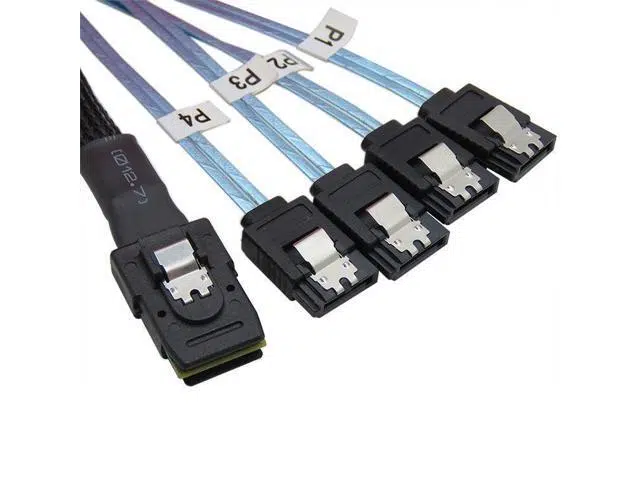
A trusted specialty supplier of SAS cables connects years of professional experience, strong research and development (R&D), and unsettled adherence to the global standards. As an example, the manufacturers that have more than 10 years of experience in the field, such as those founded in 2012 and further, are likely to be good at the engineering of high-speed cables, such as SAS, SATA, PCIe, OCuLink, and Slimline series. This experience is not just made, it is established on the basis of dealing with complicated server and industrial equipment demands where even the slightest signal interference may translate into expensive downtimes.
Another hallmark is strong R&D capabilities. The leading manufacturers are investing in the innovation of tailor-made solutions to tackle certain challenges e.g. reduction of crosstalk in densely populated data centers. They also work hand in hand with the clients to design and test designs and standards until the cables are of the right length, connector type, and performance levels. The rule of compliance is absolute; you should seek such certifications as UL, ISO9001, RoHS, and REACH that prove compliance with safety, environmental, and quality standards. Not only do these standards guarantee reliability of the product, but also result in the establishment of trust, as it demonstrates that the manufacturer is transparent and accountable in his/her operations.
This is in practice to mean a supplier capable of supporting standard HD Mini SAS cables up to custom assemblies to support RAID. Their experience is a bonus in regards to less failure in actual application where cables are to endure vibrations, heat as well as constant flow of data. By these basic attributes, manufacturers can compete in a market that has a high stake with cloud computing and big data analytics.
Material Selection and Cable Design Integrity

The central concept of designing a high speed SAS cable is ensuring that an appropriate selection of materials is made that will enhance the transmission of the signals. Manufacturers of high quality choose low-loss, high frequency conductors in the 28AWG-32AWG range that are flexible enough and attenuate and propagate as lowly as possible. These conductors are frequently designed with oxygen free copper or silver-plated variations so as to minimize resistance so as to maximize conductivity, which is important to maintain signal strength over further distances in server racks or storage arrays.
Shielding is a very important element in maintaining the signal integrity. Designs that are advanced take into account multi-layer shielding, a mixture of foil and braid shielding, to practically reduce EMI and crosstalk. This is more especially so in an environment such as a data center where there will be a number of cables running concurrently and the effects of other power sources of other signals might interfere with the performance. Controlled impedance with a typical goal of 85 0 with a tolerance of 10 is applied to ensure signals propagate without reflections and data errors in the high-speed SAS protocols are eliminated.
Another important feature of custom SAS cable assembly materials is proper twisting of pairs of wires. The presence of twisted pairs aids in cancelling noise and accurate control of pitch ensures that electrical properties are controlled in a constant manner throughout the length of the cable. In the case of a RAID of two or more drives, bad design would result in bit errors or diminished throughput. High performance manufacturers in this area employ simulation software in the design stage to forecast and optimize performance based on engineering experience to incorporate long-tail responses such as abrasion-resistant jackets, or environmental compliance halogen-free materials.
In the end, these options are not only technical, but that proves the dedication of a manufacturer to durability. Such designed cables have a capability of withstanding thousands of mating cycles before they start deteriorating, so they can be used in mission-critical use cases where reliability is the key concern.
Manufacturing Process and Quality Control
Precision and efficiency in the SAS cable manufacturing process are the factors that turn raw materials into assemblies with guaranteed reliability. Manufacturers of high quality use automated precision crimping and soldering to provide uniform connections. This automation cuts in the human error which can produce in large volume without compromising the quality of production- imagine it as creating a prototype by hand and then taking a larger scale to enter into the company.
Good quality is incorporated in all the stages. A 100% continuity test is used to test the presence of open or short circuit, and an eye-diagram test is used to test signal quality under pseudo real-world conditions. Acceptance Quality Limit (AQL) inspection is a statistical sampling of defects with supplementary visual inspection of cosmetic problems such as insulation damage. Burn-in testing, in which cables are put under high temperature and voltage, are used to simulate long-term operation to filter out possible failures during early stages of operation.
Raw wires can be cut and stripped in a normal workflow, after which they are assembled with connector such as SFF-8087 or SFF-8643. Protective features are coated with cover and the coating is overmolded. High-tech equipment comes in with inline testing gear that measures real-time impedance and insertion loss to make sure every dollage is of SAS cable quality testing standards. In the case of data center applications, such rigor implies cables capable of smooth data exchanges within the RAID configuration without causing bottlenecks that may cause the system to stall.
In following these processes, the manufacturers do not only meet the standards but also give traceable records, which further creates confidence among the clients who require transparency in their supply chains.
Testing and Certification Requirements
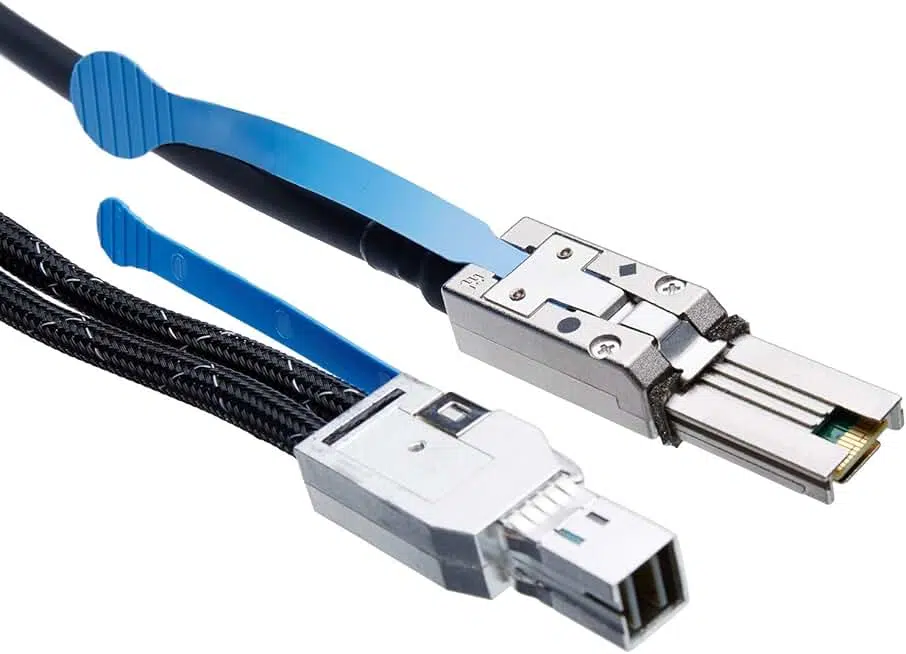
None of the high-quality SAS cables get out of the factory without thorough testing and certification. Important compliance standards are UL which is safety compliance, CE which is compliance in European markets, RoHS and REACH which are compliance in environmental restrictions and also, the ISO9001 which is the generally accepted quality management systems. These certifications are not badges, they help establish that the cable will not cause any hazard or even break down before its time.
This phase involves signal integrity tests. The insertion loss is a measurement of how much signal is lost in the cable and the return loss is a measure of reflections which may result in error. In the case of SAS cables, these tests will verify interoperability with high-speed protocols, and usually with network analyzers will be used to produce detailed reports. In server setups, where the bandwidth may reach 12 Gbps and beyond, passing these tests is an indicator of consistent operation with no retransmissions to slacken systems.
Such documentation as Quality Control (QC) reports and Certificates of Analysis (COA) also contributes to buyer confidence. They describe the results of tests, material compositions, and batch traceability enabling the clients to audit the suppliers. In the case of industries such as the medical sector or the financial sector where integrity is vital to data, such transparency is priceless. Finally, strong SAS cable certification protocols will mark high-end manufacturers, and their products will be able to stand the test in the international markets.
Customization and OEM/ODM Capabilities
The major strength of major custom SAS OEM providers lies in flexibility. They provide a wide range of connector types, including SFF-8087, SFF-8643 or SFF-8654, variable connector length, custom labeling and special packaging to meet OEM and ODM requirements. The flexibility is especially useful when it comes to international customers who are creating custom server systems or attaching cables to customized hardware.
As an example, a data center operator may need cables with a higher bending radius in tightly constrained areas or a special color-coding so that it can be easily identified. The suppliers of ODM SAS cables in China, whose production can be scaled, are able to prototype them very fast, and improve them with client feedback. This is also applicable to the addition of features such as low-smoke zero-halogen (LSZH) jackets to prevent fire or feature-durable design to be used in industries.
These manufacturers are the best to collaborate with in high volume orders because they have in-house R&D that allows them to lower lead times and costs. Finally, high levels of customization also mean that cables are not off-shelf, but adapted to the specific needs of your application, improving the overall work efficiency of the systems.
How to Evaluate a SAS Cable Supplier
There should be a methodology in selecting the most suitable SAS cable manufacturer. Begin with a check list: Check on certifications such as ISO and UL, ask about testing procedures (e.g. eye-diagram and burn-in), ask about production capacity that is related to your scale, and ask about customer references or case studies. An open supplier will easily supply datasheets of materials and QC reports.
Look out red flags, which include a lack of clarity in technical queries, absence of in-house testing resources, or irregular delivery schedules. Manufacturers of poor quality may compromise on the quality of the materials, and the failure rate of signal integrity SAS cable applications may increase. Instead, give attention to those who have already recorded performances in SAS cable suppliers in China markets where cost-effectiveness is of high standards.
Visiting the facilities or making audits is worth considering so that one can see the processes with their own eyes. In the case of RAID systems or data centers, you can use test samples in your environment to ensure compatibility. You can achieve this by concentrating on these areas, and you will have a partner that offers you more than the product; peace of mind by having a partner who delivers the expected performance.
Conclusion
Design accuracy, rigorous testing and open quality control require a high quality SAS cable manufacturer to be able to provide reliability. Since the choice of high quality materials up to designing assemblies to fit certain requirements, these factors guarantee the perfect working of cables in high-stake areas.
Need a reliable manufacturer of custom SAS cables? Professional solutions may be obtained through contacting Dongguan Kingda Electronic Technology Co.,Ltd. As we specialize in the high-speed transmission cable and quality first, we are willing to contribute to your new project.