
Introduction
Quality assurance is not an option to HDMI cable industry; it is the basis of reliability, brand confidence and adherence to international standards. Being a product manager at Dongguan kingda Electronic Technology Co., Ltd, a professional manufacturer of high-speed transmission cables in Guangdong, China, I have supervised thousands of production batches where a single missed detail, such as a bad solder joint or bad shielding, could cause flickering 4K signals or total failure in an AV system of a customer. This is made worse by the increasing number of fake cables infiltrating the markets across the world that purport to be HDMI 2.1 but fail when subjected to load, tarnishing the reputations of B2B partners and costing them money in the form of returns.
Our professional OEM factories are fighting this by multi-stage testing and strict quality assurance to deliver consistent performance of every cable 4K, 8K or even 10K uses. This paper discusses the quality assurance of HDMI cables, the dangers of counterfeits, the quality assurance process in our factory, the essential test steps, the certification, and the recommendations to observe when buying bad products. Based on our experience since 2012 when we started working on individualized solutions to servers, industrial equipment and AV system, I will provide insights so that importers, distributors and corporate buyers make better decisions. Kingda has not merely a quality first policy, but has implemented its philosophy at every stage of the process, including material acquisition and shipment.
Why Quality Assurance Matters in HDMI Cable Manufacturing
Quality assurance in HDMI cable manufacturing is not about checking boxes but providing cables that can be used in real world conditions, be it high bandwidth 8K video streaming or transferring signals over a noisy world. A low-quality QA introduces such problems as the loss of the signal at 4K120Hz, audio outages in the eARC configurations, or even the safety threat due to the defective insulation. In the case of OEM clients, it will result in product recalls, missed contracts and loss of trust- issues that we have prevented among partners in Europe and the US through keeping strict control.
Basically HDMI cable quality control is necessary to keep signal integrity at high bandwidths where even a 5% mismatch in the impedance will be reflected and produce errors. In the case of B2B buyers, QA would affect the life-span of the product: Cables that are well-tested have a lifespan of 10,000 or more mating cycles and those with low cost have 1,000 or less. Counterfeits which affect supply chains globally have uneven performance that saturates the markets at the expense of legitimate manufacturers. Failures of HDMI cables cannot be compromised when it comes to digital signage or medical displays when downtime is worth a thousand dollars. At Kingda, HDMI cable OEM production focuses on quality assurance in establishing long-term relationships showing that effective testing is not a cost, but investment in business success.
The Risk of Counterfeit or Non-Certified HDMI Cables
The planetary market of fake HDMI cables is such that the counterfeit labels as HDMI 2.1, and the cable supports barely 4K 30Hz to facilitate the compatibility nightmare and the safety risk. They typically consist of low quality copper, thin shielding, or non-conforming connectors and tend to create problems such as flickering of video, loss of audio synchronization, or even fire up to poor insulation. In early 2023 the HDMI licensing administrator said that over 50 percent of high-end online cables sold as such by the HDMI LA were fraudulent, harming brands and leaving consumers liable.
HDMI certification is also genuine by being registered as HDMI Adopter, and factories are subject to Authorized Testing Centers (ATC) verification. Fakes do not go through this, counterfeiting labels in order to undercut prices. Example A counterfeit of 8K-ready that we disassembled at Kingda exhibited 20 percent signal loss at 4K60Hz due to mismatched impedance. In the case of B2B, this is the failure of client audits or warranty claims. HDMI authorised manufacturer such as ours at Kingda is traceable- we do not want to fall into the trap of HDMI cable conformity problems in international markets.
HDMI Cable Quality Assurance Workflow in OEM Production
In a professional OEM such as Kingda, QA is also applied at the initial stage and as per ISO 9001 guidelines to be consistent. Our HDMI cable quality assessment plan varies as:
- Inbound Reviews: We check the conductivity of copper (OFC or tinned), shielding against EMI resistance and PVC/TPU jackets against flame resistance. Batches that do not comply are rejected- last year, 5 percent of the suppliers of poor foil were caught.
- In-Process Quality Control (IPQC): During assembling, automated optical systems (AOI) are used to check the accuracy of soldering and crimping force. Live checks are done to ensure that there is no space between shields that leads to leakage of EMI.
- Finished Product Inspection (FQC): 100% of the cables are subjected to electrical and mechanical tests prior to packaging- defects such as loose pin which may fail in the field are identified.
- Outbound Quality Assurance (OQA): Batch random sampling consists of bend tests and environmental tests, and will be fully documented to be audited by clients.
The HDMI cable inspection will reduce defect rates to less than 0.1 per cent and will guarantee that HDMI cable OEM production satisfies the B2B requirements of scalability and reliability.
Key Testing Protocols for HDMI Cable Reliability
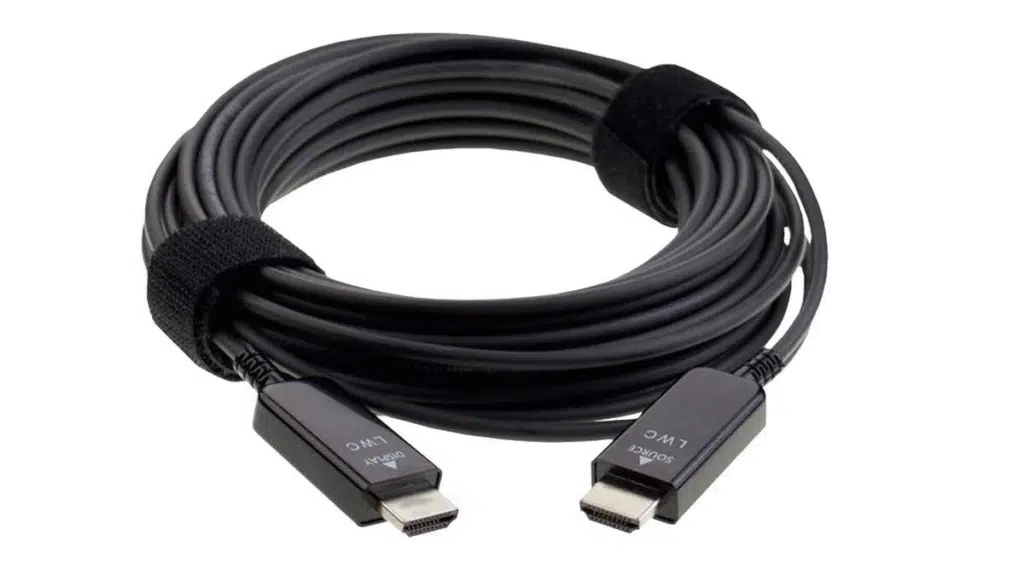
Theory is tested reality, our protocols at Kingda include electrical, mechanical, environmental and EMI to reflect the client usage.
- Electrical Performance Tests:
- Continuity & Short Circuit Test: Checks all 19 pins on the assembly board to opening/short, no assembly defects.
- TDR (Time Domain Reflectometry): Reflectometry of impedance by mapping (100 + 10 2 – 1), which is critical in HDMI cable impedance testing to preclude reflections at 48 Gbps.
- Eye Diagram Testing: Plots jitter and noise margin Visual representation of jitter and noise margin. Wide “eyes” indicate clean signals at 8K60Hz.
- Insertion/ Return Loss: Meters loss and reflection in frequencies, aimed at < -15 -dB return loss to achieve stable transmission.
- Mechanical Tests:
- Bend and Flex Test: 10,000 cycles at minimum radius (checks the durability will not show any cracks in the shield).
- Pull Force Test: Tests Makes 50 N or more to joints, proving HDMI cable robustness in tension.
- Environmental Tests:
- Thermal Aging: 85 o C -72 hours to duplicate server heat.
- Humidity Resistance: corrosion checks 95% RH at 40 o C.
- EMI & Crosstalk Testing:
- Echochemical Noise simulations of chambers, including settlement of shielding 1-10 GHz interference, FCC/CE.
These HDMI cable test standards are compatible with HDMI-ATC requirements and these test 99% of problems. The HDMI cable eye diagram represents our laboratory experiment findings of a well-reshielded signal being retained sharp.
Certifications and Compliance in HDMI Cable Manufacturing
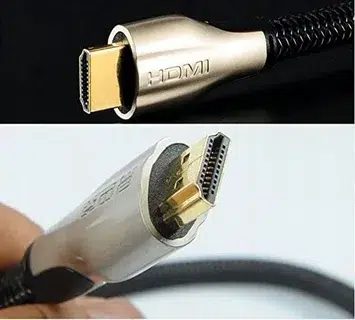
Certifications are your guarantee of the fake, HDMI certification requirements include HDMI ATC bandwidth and EMI testing. We are HDMI Adopters at Kingda where we are subject to quarterly audits.
Key certs:
- HDMI ATC Certification: 48Gbps 2.1.
- UL and CE: Electrical safety.
- RoHS / REACH: Environment.
- ISO9001: Process quality.
Our HDMI cable compliance factory and Custom HDMI cable would ensure that B2B clients comply with global regulations and not hold-ups by the customs or liability.
Detecting Counterfeit or Substandard HDMI Cables
Spot fakes with these tips:
- Check HDMI Hologram/QR Code: Authentication Scan HDMI.org.
- ID Checker Adopter: True manufacturers participate in HDMI portal.
- Test Connectors: Is Gold plating consistent? Strain relief solid?
Counterfeiting HDMI cable alerts spares headache- HDMI cable testing with devices such as multimeters provides continuity. Certified suppliers are the first stage of HDMI brand protection.
OEM Factory Best Practices for Quality and Reliability
Major OEMs make QA a fundamental part: At Kingda, we have metrics monitoring by SPC, pin inspections by AOI, and QA personnel training. Process control HDMI cable The HDMI cable process control has batch serialization of recalls. HDMI cable QA system saves money- our defect rate 0.05.
Conclusion — Quality Is the Real Brand Protection
The only actual countermeasures to counterfeits and performance problems in the competitive HDMI cable industry are rigourous quality assurance and testing.
In search of HDMI cables that are certified and tested by OEMs to endure? Oversee and reach out to Dongguan Kingda Electronic Technology Co., Ltd contact as a professional HDMI production and quality assurance way out.