
Introduction
The Mini SAS SFF-8087 pinout is important to understand to obtain effective, noise-free connections with the enterprise servers and storage systems. Since every case of intermittent data errors can be solved with an extra hour of troubleshooting and even creating custom assemblies to fit dense racks, having that specific signal mapping and wiring deployment can save time and money of costly downtime and guarantee maximum performance at 6 Gbps per lane. I have years of experience in the trenches of data center construction, where a pin mismatch or low shield continuity had a construction upgrade, a multi-day debug session became a headache in this guide I am trying to spare you.
We will begin with the macro and go down to the micro: we will have a summary of the connector, then detailing pin out, signal definitions, internal wiring pattern, breakout layout, pitfalls and testing, and why custom manufacturing is better than standard. This resource contains the fundamentals of SFF-8087 pinout and Mini SAS cable wiring to stable SAS cable connector layout whether you are wiring a RAID controller or any system integrator.
Overview of Mini SAS SFF-8087 Connector
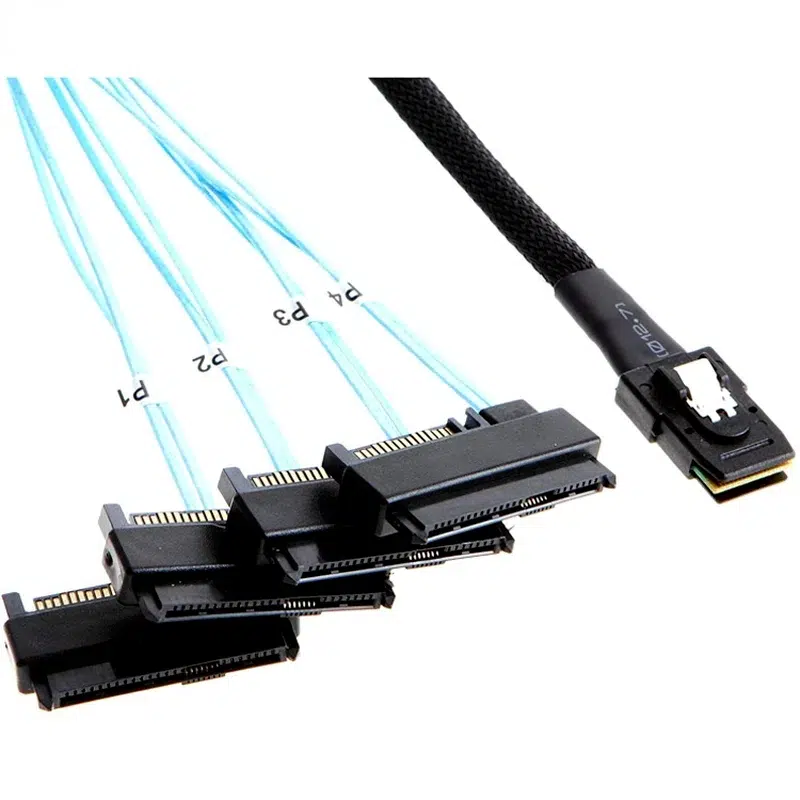
The Mini SAS SFF-8087 connector, which belongs to the SAS-2 standard, which is introduced around 2009, is a 36-pin internal connector, which is intended to be used in high-speed data transfer in storage environments. It has four 6 Gbps lanes of serial communication, adding up to 24 Gbps – more than enough to connect RAID controllers to the backplanes or drives of servers such as Dell PowerEdge or HPE ProLiant servers.
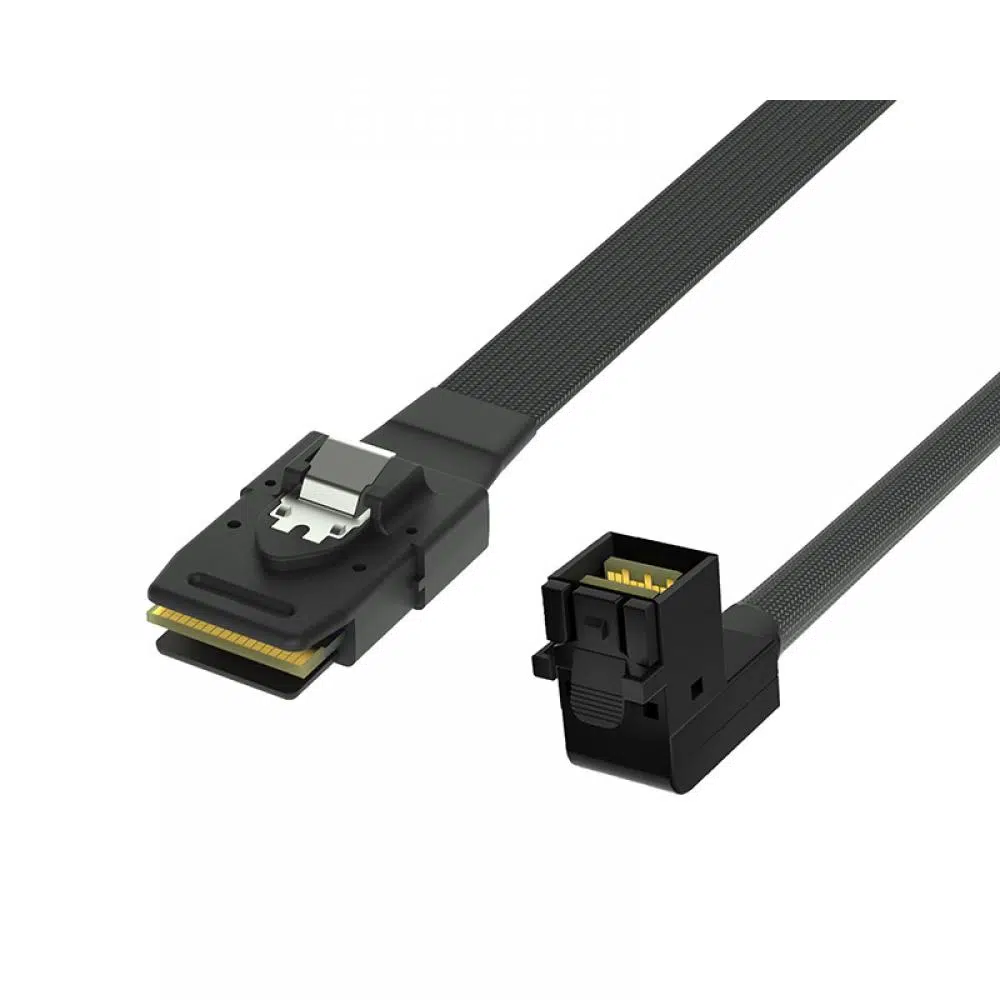
Physically, it is a small, rectangular plug that has a latch-lock design to be firmly clamped and is not easy to vibrate when placed in rack-mount application. The Mini SAS SFF-8087 connector has differential signaling as a noise immunity and pins are clustered into transmit (TX), receive (RX), grounds, and sidebands. In common usage, it is a bridge that connects host bus adapters (HBAs) or RAID cards to power enclosures to allow internal cable propagation with the SAS that is compatible with SATA to hybrid arrays.
This SAS backplane connection standard is ideally suited in an enterprise situation where space usage is limited and reliability is the key issue. Its configuration is much more dense than that of its bulkier predecessors, and its form factor is such that you can get it dense, but only with a high-quality wiring, and then you have to contend with crosstalk or signal attenuation that will slow down your storage.
SFF-8087 Cable Pinout Diagram Explained
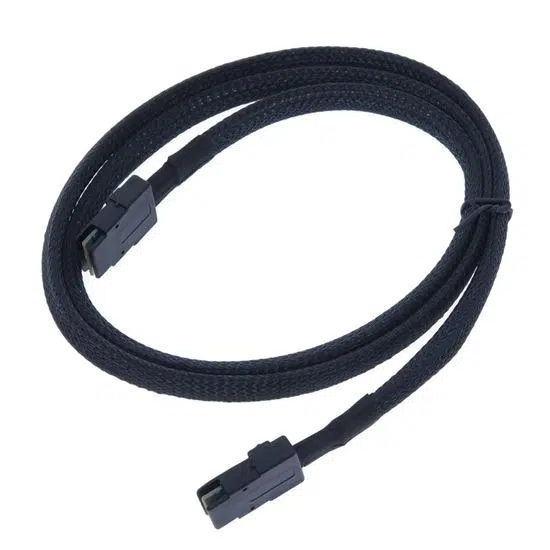
SFF-8087 pinout is designed to be used in a balance, multi-lane form (36 pins on four channels A to D). The lanes each have TX and RX differential pairs, several grounds to enable isolation, and shared sideband pins to manage the lanes such as SGPIO (Serial General Purpose Input/Output) to control LEDs or drive status.
Here’s a detailed pinout table based on the SFF Committee specifications:
| Pin Number | Signal | Description | Lane/Group |
| 1 | SAS_TX_A+ | Transmit positive for Lane A | Lane A |
| 2 | SAS_TX_A- | Transmit negative for Lane A | Lane A |
| 3 | GND | Ground | Lane A |
| 4 | SAS_RX_A+ | Receive positive for Lane A | Lane A |
| 5 | SAS_RX_A- | Receive negative for Lane A | Lane A |
| 6 | GND | Ground | Lane A |
| 7 | SAS_TX_B+ | Transmit positive for Lane B | Lane B |
| 8 | SAS_TX_B- | Transmit negative for Lane B | Lane B |
| 9 | GND | Ground | Lane B |
| 10 | SAS_RX_B+ | Receive positive for Lane B | Lane B |
| 11 | SAS_RX_B- | Receive negative for Lane B | Lane B |
| 12 | GND | Ground | Lane B |
| 13 | SAS_TX_C+ | Transmit positive for Lane C | Lane C |
| 14 | SAS_TX_C- | Transmit negative for Lane C | Lane C |
| 15 | GND | Ground | Lane C |
| 16 | SAS_RX_C+ | Receive positive for Lane C | Lane C |
| 17 | SAS_RX_C- | Receive negative for Lane C | Lane C |
| 18 | GND | Ground | Lane C |
| 19 | SAS_TX_D+ | Transmit positive for Lane D | Lane D |
| 20 | SAS_TX_D- | Transmit negative for Lane D | Lane D |
| 21 | GND | Ground | Lane D |
| 22 | SAS_RX_D+ | Receive positive for Lane D | Lane D |
| 23 | SAS_RX_D- | Receive negative for Lane D | Lane D |
| 24 | GND | Ground | Lane D |
| 25-32 | Sideband (SGPIO) | Control signals (e.g., activity LEDs) | Sideband |
| 33-36 | Reserved/GND | Grounds or unused | Misc |
This SFF-8087 pinout layout is arranged in logical groups: the TV/RX pairs are interleaved with grounds in order to shield against EMI, and the impedance is 85-100 Ohms. SAS signal mapping is used to ensure host to device flow; TX controller to drive, RX reverse. Practically, the connector is oriented: connector is with the latch up; pin 1-18 on the top 19-36 on the bottom. In the case of SAS connector layout, keying stops the insertion of the connector upside down, however, always check with a multimeter before power is switched on.
Understanding Signal Flow in SAS Architecture
In SAS architecture, the data flows through pairs of TX/RX as differentials, positive and negative voltages that cancel common noise to enable the data to be strongly transmitted. This is supported by the SFF-8087 with four independent lanes with 85 O differential impedance to minimize reflections that would cause bits errors at 6 Gbps.
Signal flow begins at the controller: TX pairs transmit the data to be sent to the drive RX in a serial manner, and the TX of the drive is fed back to the RX of a controller. SAS TX RX pairs are negotiable in both directions but committed on connection. Ground isolation of pairs is used to limit crosstalk, which is important in multi-lane systems where interference may be a problem.
An important subtext: Straight vs reverse cables. Host-to-backplane Straight cables use the same pinout on each end: reverse (or fanout) flip RX/TX (direct drive connections). Combining them gives rise to no-link problems–over the years I have corrected dozens of them by changing to the correct type. In the case of SAS signal flow, it is always good to simulate the design in software such as OrCAD in case of a custom design to ascertain integrity.
Internal Wiring and Shielding Design

The wiring in an SFF-8087 cable is a masterpiece of fineness: 28-30 AWG twisted differential pairs (per TX/RX) and bundled with grounds and sidebands. Each pair was twisted at a certain pitch (i.e. 10-15 per inch) to achieve balance of inductance and capacitance and approach that 85 ohms sweet spot.
Shielding is stacked Individual pairs are high-frequency EMI rejected with aluminum-foil wraps, then a blanket braided shield (copper or tinned) for low-frequency protection, with 90%+ coverage. A drain wire is used to attach shields to ground pins and drain noise. PVC or LSZH is used as a jacket in SFF-8087 internal wiring in order to provide flexibility and fire safety.
Thinking cross-sectionally, the pairs of core, foil, braid, outer insulation are concentric. This cable shielding design contains crosstalk to less than -30 dB, which is important in racks of noise. In twisted pair SAS cables, automation is necessary to guarantee consistent twists – errors by human beings are high in an attenuation spike. Manufacturers such as us at Kingda provide quality builds such as inline testing to test continuity of shields.
Mini SAS SFF-8087 to SATA Breakout Cable Wiring
Breakout cables dividing one SFF-8087 into four SATA connectors are used to connect SAS lanes to SATA ports in mixed arrays. SATA Port 1 is between Lane A (TX to SATA TX, RX to RX) and SATA Port 2 (TX to SATA TX). Port 4 D TX to SATA TX). Grounds are shared, keying is required to align SAS with SATA-SATA-SATA: SATA is pin-based (1-7 per port) and sidebands are not supported.
In the SFF-8087 to SATA breakout wiring, reverse pinout is often used as a convenience to match the drive orientations. This mini SAS breakout cable allows one controller port to provide four SATA SSDs at 6 Gbps each, suitable in cost-effective RAID. The SAS to SATA compatibility is maintained, but it is important to remember that the SAS controllers treat SATA drives as SAS-1, which restricts more advanced functionality.
Common Mistakes and Troubleshooting in SAS Wiring
Wiring mistakes afflict even the professionals – here are some of the pitfalls to observe:
- Misaligned Orientation: Direct connection into reverse connections produces no signal; check labels or test continuity.
- Mixing Straight vs Reverse: TX/RX swapping occurs – drives appear missing. Swap cables or use adapters.
- Poor Grounding: Poking EMI with broken drain wires; check ground continuity between shields and pins.
To trouble-shoot SFF-8087 wiring errors, begin with cable tester: Scan for opens/shorts, then scan with oscilloscope: eyeballing eye diagrams. SAS cable troubleshooting frequently shows that the pins are bent by force, and it is essential to insert it gently. In c
Testing and Verification of SAS Cable Wiring
Test: No bargain: 100% opens/shorts continuity testing each of 36 pins. Impedance test SAS cable using TDR (Time Domain Reflectometry) traces discontinuities, aiming at 85ohm +10.
Crosstalk testing is used to test NEXT/FEXT using network analyzers, guaranteed below -30 dB. The insertion loss must remain less than 6 dB at 3 GHz. SAS cable testing ends with burn-in: Stress (maximum) under temp. In accordance with UL safety and IPC/WHMA-A-620 assembly requirements, we record results as a trace. Quality check SAS wiring This and similar will ensure field reliability.
Why Custom Wiring and Manufacturing Quality Matter
Basics can be done off-the-shelf, but Mini SAS cable custom is the best to do when more efficient routing is needed, such as the precise lengths needed cut the cable clutter, allowing the air to flow freely and save 20% of the airspace. Accurate shielding and impedance minimizes inaccuracies in large installations.
Kingda is a SAS cable manufacturer in China and is in a good position to compete in custom cable assembly OEM: Simulations in R&D: We provide consistent performances in automated crimping. Clients receive full-report assemblies of RoHS-compliant, customized to your backplane.
Conclusion — Precision Wiring Ensures Reliable Data Flow
Proper pinout knowledge and superior wiring layout make sure of the repeatable and high-performance speed of SAS. Crack these, and your storage systems will work perfectly.
Require quality Mini SAS SFF-8087 cable assemblies? See Dongguan Kingda Electronic Technology Co.,Ltd Contact Dongguan Kingda Electronic Technology Co.,Ltd for highly-engineered, fully-tested custom solutions.