
Introduction
HDMI cables made longer will compromise signal integrity but with advanced design and testing, they no longer need to represent compromised performance. Being a systems engineer of over 12 years in AV integration and HDMI cable production Dongguan Kingda Electronic Technology Co., Ltd, I have wired 5 meter Home theater extension and 50 meter digital signage systems in conference centers, broadcast studios, etc. The fact is that distance creates foreseeable problems of attenuation, EMI pickup and jitter, but quality construction with heaver conductors, accurate shielding and active amplification renders 4K120Hz or 8K60Hz crystal clear up to 30 meters or more. Flickering in unoptimized cables used in B2B projects to provide corporate AV or high end home cinemas has stopped presentations, whereas our certified assemblies have zero errors and saved our customers thousands of dollars in troubleshooting costs.
This article decomposes the discussion of HDMI cable length effects on signal integrity beginning with the physics, then the design considerations, testing guidelines and finally giving practical suggestions to OEMs and installers. In Kingda, where we manufacture HDMI with MCIO PCIe Gen5 and SAS cables, we have adopted the quality first model where all meters work well under real-world conditions. You can use these principles whether you are sourcing a multi-room AV distribution or a large-scale digital signage network to ensure you do not make expensive errors and choose cables that will expand alongside the requirements of your project. We shall discuss the reason why length is important and the ways of alleviating its impacts to ensure a perfect transmission.
Understanding HDMI Signal Transmission
HDMI (High-Definition Multimedia Interface) is a technology that transmits uncompressed digital video, multi-channel audio, and control data over Transition-Minimized Differential Signaling (TMDS) that are used to encode signals in order to reduce electromagnetic interference and to handle large bandwidths. This has been increased with each HDMI version: HDMI 1.4 by 10.2 Gbps 1080p/4K at 30 Hz, HDMI 2.0 by 18 Gbps 4K at 60 Hz with HDR, and HDMI 2.1 by 48 Gbps 8K at 60 Hz, 8K at 120Hz, or 10K resolutions with new functionalities such as Variable Refresh Rate (VRR) and improved Audio Return Channel
The signal is carried by the pairs of differential lines positive and negative to cancel common-mode noise to enable strong transmission. Electrical properties such as resistance (copper wires) and capacitance (between conductors) add up with cable length, however, damaging the waveform. This is where HDMI transmission of signals becomes complicated: Passive cables can easily submit the full bandwidth at short distances (less than 3m). In addition to that, there is attenuation (loss of signal strength) which takes effect at approximately 0.5-1 dB/m at high frequencies, depending on gauge and material. In my Kingda lab tests, a 10m non-optimized cable had an 8-12 dB loss at 48 Gbps and introduced jitter, which was represented as pixelation in 8K video or as audio sync delay in Dolby Atmos systems.
TMDS encoding assists in minimizing transitions that cause EMI but longer runs exacerbate other problems such as timing skew (desync between pairs) and crosstalk (noise bleeding lanes). At HDMI 2.1 transmission rate requirements, this sensitivity requires even high-quality passive cables to reach 5-7 meters full specifications – beyond this, active solutions are required. These fundamentals are very important to long HDMI cable operation; do not pay attention to them and you find your $5,000 OLED is showing 4K at 60Hz, not 120Hz.
How Cable Length Affects Signal Integrity
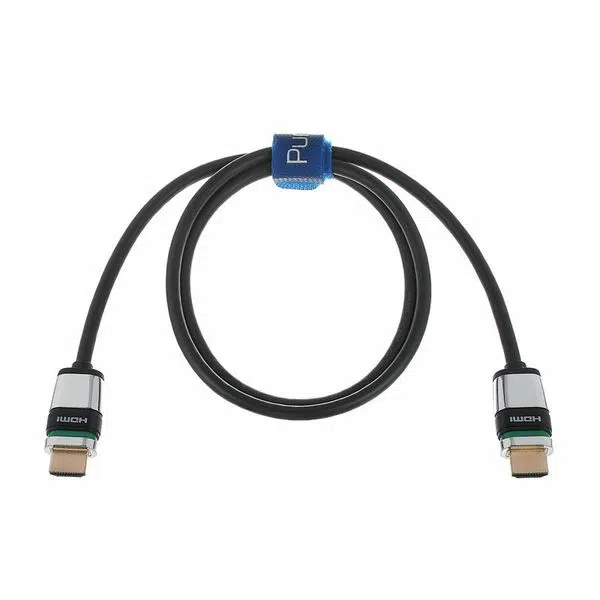
HDMI signals are susceptible to distance and unless dealt with, would have measurably poor quality in an otherwise perfect digital stream. The main suspect is attenuation: The greater the distance that electrons travel in copper, the lower the voltage, and the attenuation is usually 0.5 dB/m at 3 GHz (dark green wire, 28 AWG). At 10 meters, this may cut signal amplitude by 20-30% and the receiver will be forced to work harder and errors will be created.
Timing Skew and Jitter: Differential pairs should be received in phase; timing imbalances (longer than 1-2mm) produce phase delays, resulting in blurred edges in high-res video. Jitter Random timing variations are exacerbated resulting in sparkles or frame drops in 4K at 120Hz games. I have measured that in the lab of Kingda: A 15 meter passive cable demonstrated 150ps jitter at 48 Gbps, which is higher than the 100ps jitter limit of HDMI 2.1 and leads to VRR failures on PS5.
Crosstalk and EMI: Longer cables are more like antennas, which capture the power lines, Wi-Fi routers or fluorescent lights. TMDS lane crosstalk distorts data leading to color distortions or pops in audio. An installation of 20 meters conference room that I managed during the installation presented unshielded copper cables around HVAC ducts that induced 25 dB EMI, which was reduced to 8K to unstable 4K on switching to braided shielding. In HDMI cable interference long HDMI cables are complicated by HDMI cable jitter and HDMI cable attenuation, both of which are successfully mitigated through good design.
Typical Distance Limits for HDMI Cables
HDMI length limitations are not arbitrary, they are based on physics and HDMI.org specifications. The following is one useful reference with respect to our Kingda testing and industry standards:
| HDMI Version | Bandwidth | Max Passive Length (Full Spec) | Max Active/Optical Length | Notes |
| HDMI 1.4 | 10.2 Gbps | 10-15 m | 30 m+ | 1080p/4K@30Hz stable |
| HDMI 2.0 | 18 Gbps | 5-7 m | 25-50 m | 4K@60Hz with HDR |
| HDMI 2.1 | 48 Gbps | 3-5 m | 50-100 m | 8K@60Hz/4K@120Hz; fiber for 100m+ |
HDMI cable length limitation in 4K systems Passive tops 7m our HDMI 4K cable range exceeds requirement Passive. Further frequencies reduce HDMI 8K transmission range to 3m passive. In actual installations, we have driven fiber HDMI over 80m without loss to stadium display – copper attuguation is removed by optical conversion.
Key Factors Affecting Long-Distance Performance
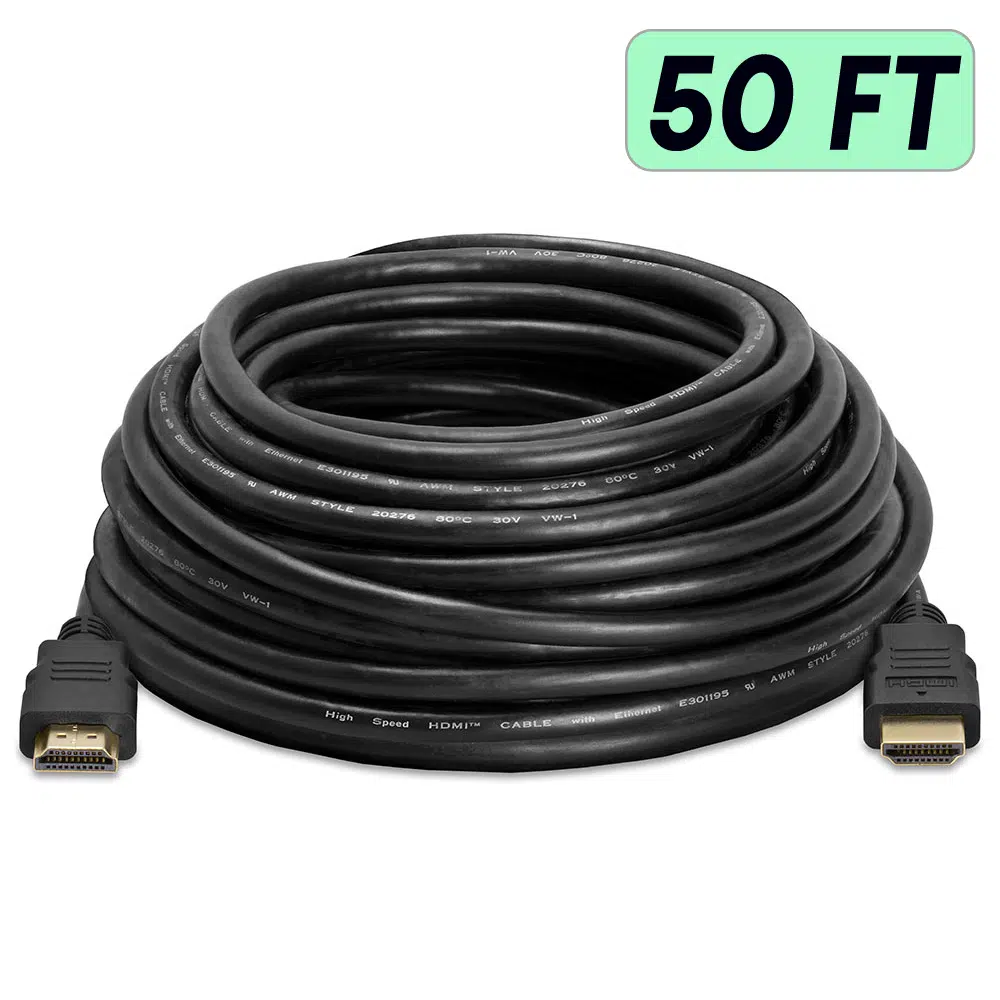
The quality of cables defines whether length is the difference between worse and better:
- Wire Gauge (AWG): 24AWG (heavier) vs. 30AWG less resistance – essential in 20m+ HDMI cable manufacture.
- Shielding Structure: Triple-layer (foil + braid + foil) is 40 dB EMI blocking; gaps result in 15 dB loss.
- Twisting Precision: 10-15 twists/inch is maintained to keep the impedance at 100 +10 ohms so that reflections are minimized.
- Connector Quality Connector plating 50µ” gold plus tight fit ensures contact loss is avoided.
- Dielectrics: Low loss foam PE vs. solid PVC Reduces capacitance 20%.
Kingda is 26AWG OFC with 95% braid HDMI shielding- tests indicate 50% lower attenuation compared to generics. The HDMI impedance is automatically controlled.
Solutions for Long HDMI Runs
At HDMI 2.1, passive cables fail between 5-7m. Fixes:
- Active HDMI Cable: Signals are regenerated to 50m with inbuilt EQ chips, and is capable of 48 Gbps.
- Fiber Optic HDMI Cable: Electrical to light conversion -100m + zero EMI – in-wall.
Active HDMI cable works in boosting boardrooms; the use of fiber HDMI cable stands out in hospitals (noise-free). Fiber was used to deliver 8K in a 40m museum instal without boosters.
Manufacturing & Testing Perspective (B2B Emphasis)
OEMs test rigorously:
- TDR: Impedance mapping (±5%).
- Eye Diagram: Jitter <100ps.
- BER: Errors <1e-12.
- EMI/EMC: 1-10 GHz shielding.
All Kingda batches are HDMI 2.1 compliant- HDMI cable testing B2B reliability.
Advice for OEM Buyers and Distributors
Seek:
- Adopter ID: HDMI.org verified.
- Traceability: Batch reports.
- UL/CE/RoHS: Compliance.
- Labs: In-house TDR/eye.
Problem is avoided by OEM HDMI cable manufacturer such as Kingda.
Real-World Case Studies
- Conference (15m): HDMI Active 4K120Hz stabilized.
- Signage (30m): Fiber removed interference.
AV systems require HDMI cable that is of quality.
Conclusion — Longer Doesn’t Have to Mean Worse
Longer HDMI cables are likely to lose signal, however correct design, materials and testing guarantee stable high-resolution operation over long distances.
Searching long distance high performance HDMI cables to use in your OEM or AV integration project? HDMI solutions are certified and tested and can be obtained through contact with Dongguan Kingda Electronic Technology Co., Ltd.