
Introduction
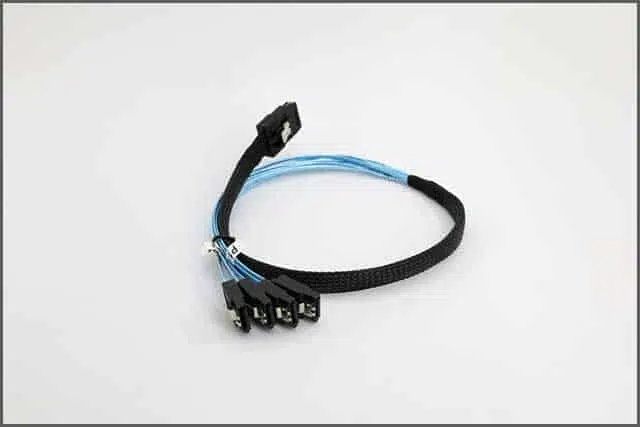
High speed, low-latency connectivity is required in AI, HPC, and data centers, and this is where custom SAS cables will be necessary to ensure reliable and scalable data transfer. In such systems, with huge volumes of data being processed by the GPU clusters and server farms in breakneck speed, the cable off-the-shelf may prove to be inadequate, resulting to signal loss, congestion, or even a complete breakdown. This can be closed by using custom SAS cables with length adjusted to the exact length, improved shielding and a connector optimized to meet the strict requirements of a specific set up.
This paper will discuss why off-the-shelf cables are limited in high-performance conditions and how the limitations can be addressed by using custom SAS solutions by seasoned manufacturers. We will explore the technical rationale, design factors, performance advantages, testing procedures, and the future trends, which are based on the practical applications such as AI training model or the hyperscale cloud infrastructure. As an engineer in data center or IT architect, you will witness how AI will make your system more efficient and more durable through investing in the custom SAS cables.
Why AI, HPC, and Data Centers Demand High-Performance Interconnects
Increases in the workloads of AI (train large language models on thousands of GPUs) have blown out the data throughput demands, frequently hitting 100 TB/s or higher combined across clusters. Otherwise, climate modeling or drug discovery high performance computer (HPC) simulations stress systems to the utmost capacity, whereas petabytes of real-time analytics are handled in a data center. Regular 1224 Gbps per lane performance is not a luxury in these worlds, but rather a necessity to eliminate any latency that might be hours of delay to processing time.
The relationship between density of data, speed and quality of cables is direct: The more nodes the tighter the cables have to be without breaking signal paths. Ineffective interconnect can cause retransmissions, overheating or scalability bottlenecks. As an example, in an NVIDIA DGX cluster to transmit AI data, poor cabling may reduce the bandwidth by 20 percent and waste computing capacity. This intensity must be supported by high performance computing cables and this aspect has made solutions such as data center connectivity such as custom SAS to be a foundation in terms of infrastructure future-proofing. Their absence even causes the most advanced hardware to perform poorly.
The Role of SAS Cables in High-Speed Systems
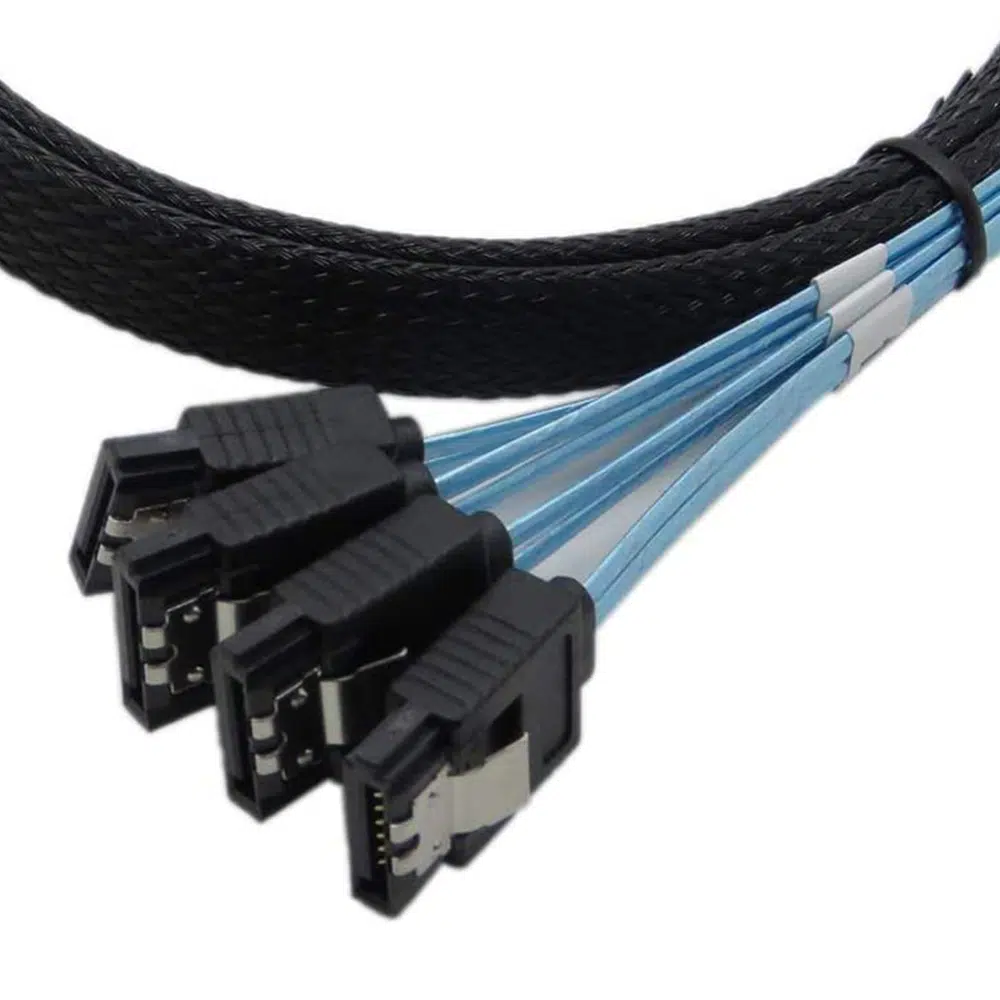
SAS or Serial Attached SCSI was an extension of parallel SCSI that offered a sophisticated, point to point connected sensor suitable in storage intensive environments. It allows high bandwidth lanes – up to 4 lanes per cable – to support aggregate 48 Gbps in SAS-3 or 90 Gbps in SAS-4 systems. This scalability is radiant in AI and HPC where SAS cable assemblies connect controllers to drive arrays, backplanes or JBOD enclosures.
Backward compatibility is a strength of SAS SAS-4 cables negotiated all the way down to SAS-2 (6 Gbps) in mixed-generation configurations, simplifying upgrades. Similarly, SAS is used in hybrid systems to combine NVMe with SSDs, PCIe with accelerators and OCuLink with compact PCIe extensions, and creates a flexible backbone. Indicatively, in OpenFOAM simulations in an HPC cluster, SAS-4 cable performance is used to guarantee the low latency data transfer between storage and CPU nodes in the cluster, avoiding I/O bottlenecks. With the increasing data requirements, SAS cables have become central to ensuring coherence between the systems as the high speed storage interconnects are integrated.
Why Custom SAS Cables Are Preferred for AI and HPC
Simple servers may only require standard cables, although with AI and HPC, the limits are pushed to a point where customization is an absolute necessity.
- Precise Length and Routing Efficiency: Custom SAS cable design enables the device to use the exact length, such as 0.3m to intra-rack GPU links, which minimize clutter in high-density designs. This enhances airflow which reduces cooling expenses by up to 10 percent in HPC cable assemblies packed with 8 or more GPUs per node.
- Improved Shielding & Signal Integrity: Custom constructions of EMI prone data centers employing power cables and RF noise include multi-layer foil + braid shielding, reducing crosstalk. This maintains signal integrity in data centers, which are essential in error-free high-frequency AI inference.
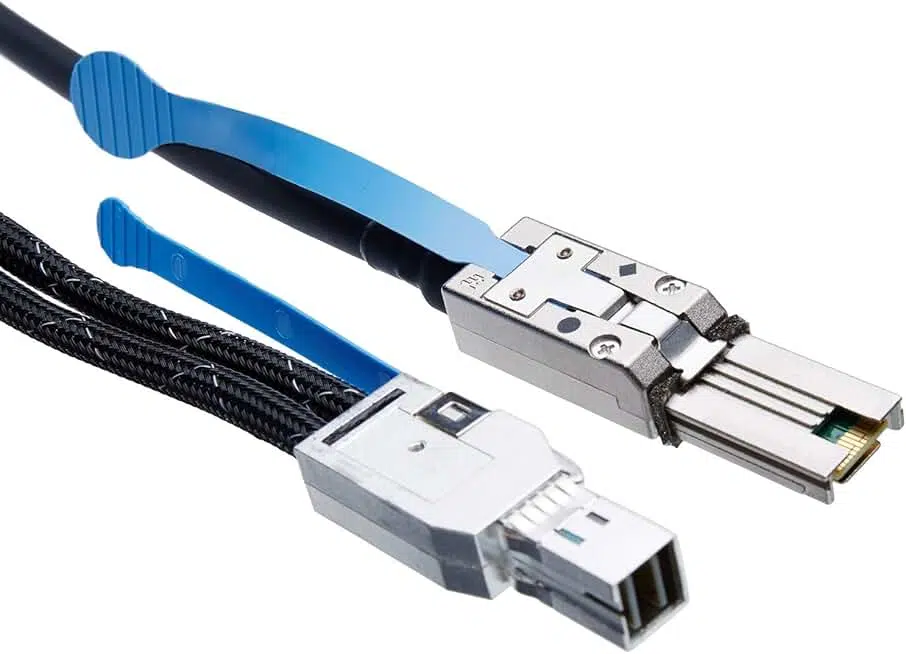
- Optimized Connectors: Such options as SFF-8643 (HD Mini SAS) or SFF-8654 (Slimline) will be compatible with the next-gen servers. An example of this is SFF-8643 SAS cables which have 12 Gbps lanes which are offered in small sizes, and are suitable in blade servers.
- Thermal and EMI: High power environments produce heat; jackets assembled with halogen-free high temperature (up to 105 C) are used to ensure they do not degrade, and the EMI shielding cables eliminate interference by components around.
My experience as an HPC project consultant has shown that with these features, long time problems with off-the-shelf systems such as signal drop in overpacked racks are solved.
Design Considerations for High-Speed AI and HPC Connectivity
The custom SAS cable design to these applications is more of physics than of a plug and play. 85 ohms ±10 percent controlled impedance is an absolute requirement to prevent reflections which increase with frequency at 24 Gbps. This necessitates accurate differential pair design twisted pairs with regular pitch and low-skew insulation to accommodate crosstalk such that NEXT/FEXT is less than -30 dB.
Materials resistant to high temperatures such as PTFE dielectrics are used in 24/7 operation of hot GPU farms, and routing (slim jackets, flexible braids) is space-efficient and does not require kinking. Simulations are used in high speed cable design to model signal paths in order to determine the performance, making HPC connectivity design scale to node density.
Compare standard vs custom in this table:
| Factor | Standard SAS Cables | Custom SAS Cables |
| Impedance Control | Loose (±15%) | Tight (±10%) |
| Shielding | Basic foil | Multi-layer (foil + braid) |
| Length Flexibility | Fixed (0.5-2m) | Tailored (0.1-5m+) |
| Thermal Rating | 60-80°C | 80-105°C |
| Crosstalk Suppression | Moderate | Advanced (low-skew pairs) |
This impedance control SAS cable focus ensures cables don’t become the weak link in AI clusters.
Performance and Reliability Advantages
Individually designed SAS cables enhance the stability of the throughput of data by ensuring clean signals, which minimize the latency of AI workloads where milliseconds count when training a model. In a HPC project that I participated in, the time spent on a 512-node cluster was reduced by 30 percent by replacing regular SAS-4 cables with custom versions, reducing transmission errors.
Overmolding and strain relief are particularly effective in SAS cable reliability: The high vibrations in mobile data centers can be withstood by sturdier design of overmolding and strain relief, whereas efficient energy use through optimal airflow is achieved in a design. Performance optimization of data centers are commonly associated with increases in I/O throughput in the range of 15-20% due to the ability of high speed data cables to avoid bottlenecks. In the case of AI that is hardware intensive (GPU), this will allow quicker iterations without hardware optimization.
Testing and Validation in High-Performance Applications
No custom cable ships without tiring inspections. Eye diagram testing compares waveforms with each other to quantify jitter and margins at full speed- necessary to SAS-4 compliance. TDR (Time domain reflectometry) is used to scan impedance discontinuities, and EMI/ EMC testing in anechoic chambers ensures shielding effectiveness against noise up to 1-40 GHz.
Burn in reliability tests apply cables under higher temperatures and voltages over a period of 168 hours which is equivalent to years of operating. We comply with the UL on safety, RoHS/REACH on eco-compliance and IPC/WHMA-A-620 on assembly standards, so that SAS cable testing is at the international level. This rigor, in combination with the data center cable standards, fosters trust in high performance cable QC, as in our deployments where the failure rates are less than 0.1%.
Custom SAS Solutions for Scalable Infrastructure
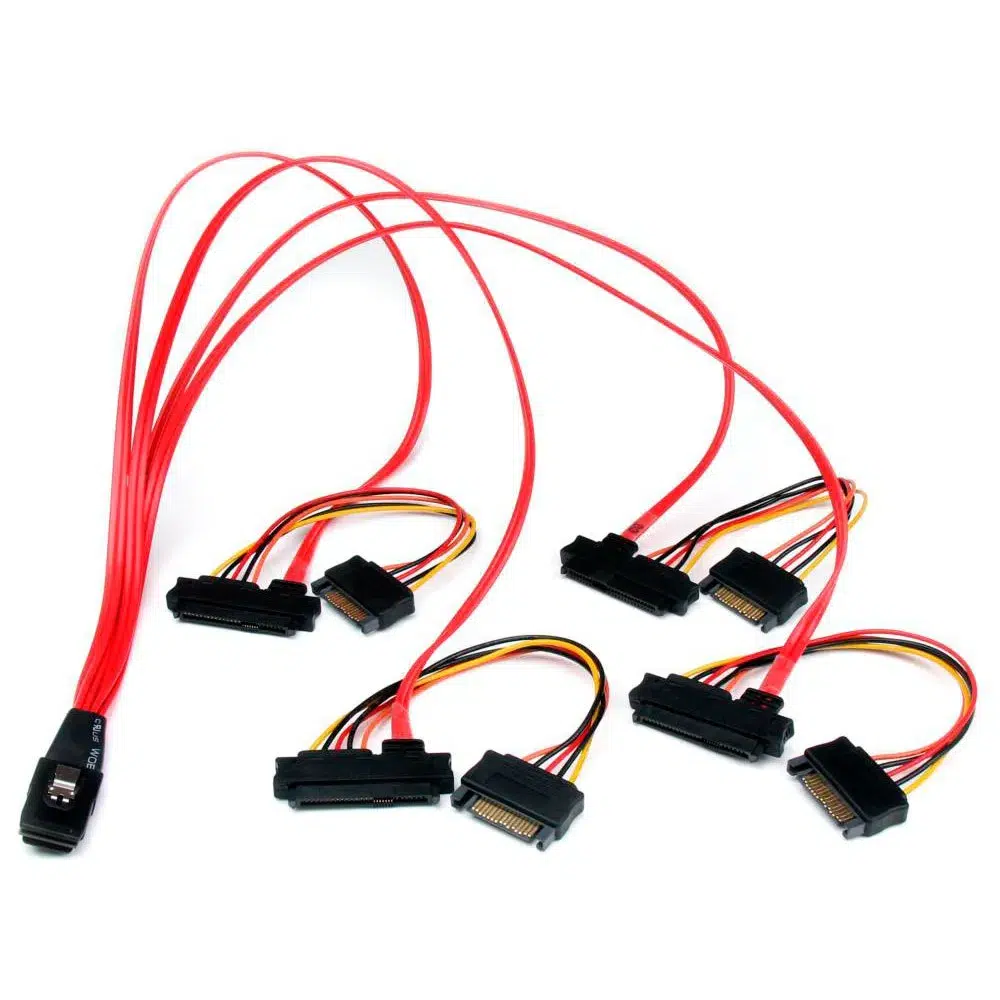
Scalable modular custom SAS cable OEM designs SAS Breakout cables are used to connect a single controller to several drives in JBODs, and hybrid assemblies are used to combine SAS with U.2 (NVMe SSDs) or OCuLink with PCIe extensions. Scalable data center cabling is flexible, so that as the number of nodes increases, it does not require rewiring.
In the case of PCIe Gen5 SAS, we at Kingda design to use silver-plated conductors to hand minimal attenuation and future-proof AI infrastructures. The scalability of the enclosures of the one cloud provider was easily achieved, which they attributed to our ODM optimizations allowing expansions to happen in zero downtime.
Future Trends — SAS in AI and HPC Ecosystems
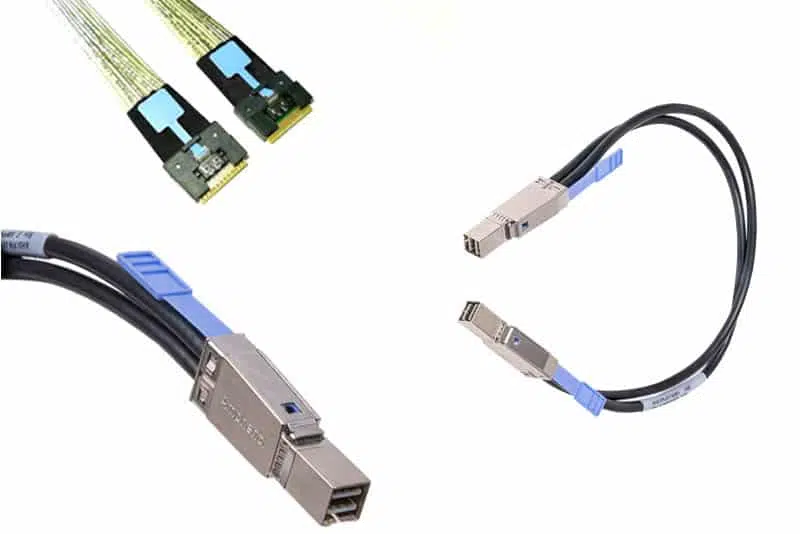
SAS-4 with a bandwidth of 22.5 Gbps/lane is only beginning; hybrid NVMe-over-SAS interfaces will enable a smooth SSD integration, with PCIe Gen6 (64 GT/s) needing some even stricter tolerances. Further SAS cable technology could include active equalization of longer runs, covering the AI edge-to-cloud data flows.
SAS-4 cable trends encourage the increased density of connector such as SFF-8654 to support the 8-lane configuration, and the next-generation data cable of AI with terabit aggregates. The low-latency and high-bandwidth cabling demand will continue to make custom solutions to be the focus.
Conclusion — Custom SAS Cables Power the Future of High-Speed Computing
SAS-specific cables provide the performance, dependability and scalability required by the next generation AI, HPC and data-center systems. They meet the specific requirements of these locations to guarantee that your infrastructure is at its best without faltering.
Need custom SAS cables with high-performance? Contact Dongguan Kingda Electronic Technology Co.,Ltd in case of precision engineered fully tested connectivity solutions. We are also prepared to customize solutions that make you successful, and because of our dedicated focus on high-speed transmission cables and also because we believe in quality first.