Uncategorized

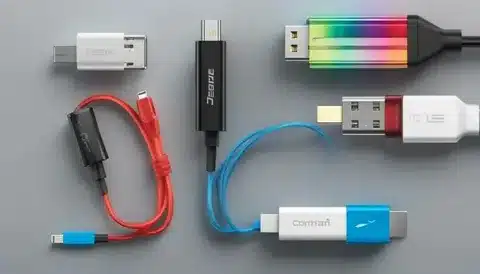
Multiple USB cables in different colors and styles highlighting length and function.
Uncategorized

How Long Can a USB-C Cable Really Be or USB-C Max Length?

A USB-C cable’s maximum length depends on what you’re using it for—power delivery or high-speed data transfer. For charging, cables can be much longer, sometimes up to 4 m (about 13 ft), without a big drop in performance. However, when it comes to data transfer, especially at high speeds like USB 3.1, 3.2, or USB4, length becomes limited: typically around 1 m to 2 m to ensure stable performance and avoid signal loss. Passive USB-C cables longer than that may struggle with speed, while active USB-C cables use built-in electronics to maintain fast data transfer over greater distances. In short, you can get away with longer cables for charging, but for reliable high-speed data transmission, shorter is always better.
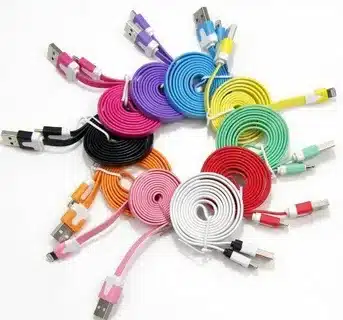
Multicolor USB charging cables highlighting cord wire color variety.
Uncategorized

USB Cord Wires Colors – What Every User Needs to Know

USB cord wire colors follow a universal scheme that helps identify each wire’s function, making it easier for users to understand or repair their cables. Typically, a standard USB cable has four main wires: red for positive power (+5V), black for ground, white for data transfer (D–), and green for data transfer (D+). Some newer or specialized cables may include additional wires for shielding or faster data protocols. Knowing these color codes is important for safe DIY repairs, troubleshooting charging issues, or distinguishing between charging-only and data-capable cables. In short, wire color coding ensures proper connections, prevents damage to devices, and helps users make informed decisions when handling USB cords.

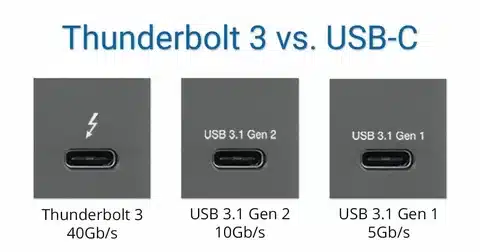
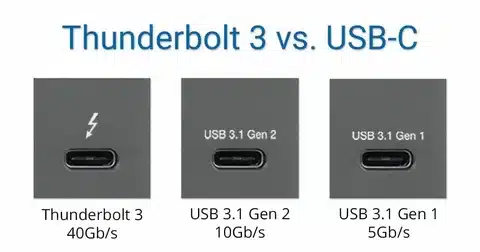
ports of Thunderbolt 3, USB 3.1 Gen 2, and USB 3.1 Gen 1 showing speed labels
Uncategorized

Is USB Type-C the Same as Thunderbolt?

USB-C is a connector standard that comes with different speeds and capabilities depending on the implementation. Thunderbolt is a version of USB-C that offers consistent and high-performance specifications with guaranteed speeds and advanced functionality.

Thunderbolt 3 port compared with USB-C 3.1 Gen 1 and Gen 2
Uncategorized

USB 3 vs Type C: Connector vs Protocol—What You Really Need to Know

The comparison between USB 3 and USB Type-C is often misunderstood because one refers to a data transfer protocol (USB 3.x) while the other describes a connector design (Type-C). USB 3.0, 3.1, and 3.2 define how fast data moves and how much power can be delivered, whereas Type-C is the physical, reversible port that can carry different USB versions and even other standards like Thunderbolt or DisplayPort. This means a device with a Type-C connector isn’t automatically “USB 3” fast—it could still run at slower USB 2.0 speeds depending on its internal wiring. In short, USB 3 defines performance, and Type-C defines shape and versatility; what really matters is checking both together to ensure you get the speed and power your device supports.

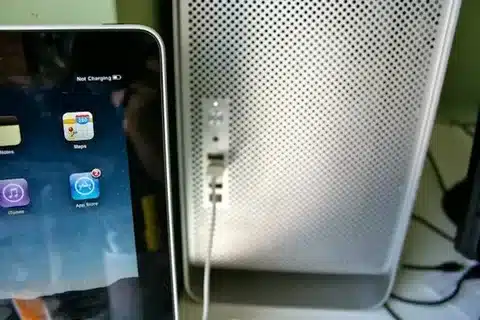
iPad Pro connected to desktop computer USB port with not charging notification
Uncategorized

iPad Pro Not Charging USB-C: Complete Fix Guide

The guide “iPad Pro Not Charging USB-C: Complete Fix Guide” explains why an iPad Pro might fail to charge through its USB-C port and offers step-by-step solutions. Common causes include faulty cables or adapters, dirty or damaged ports, outdated iPadOS, or system glitches. The guide walks users through simple checks like cleaning the port, trying different Apple-certified cables and chargers, and restarting or force-restarting the device. It also covers software fixes such as updating iPadOS, resetting settings, or performing a DFU restore if necessary. For hardware issues, it suggests inspecting for bent pins or overheating, and when all else fails, contacting Apple Support for repair or battery replacement. The overall goal is to help users quickly diagnose the issue and restore proper charging without unnecessary downtime.

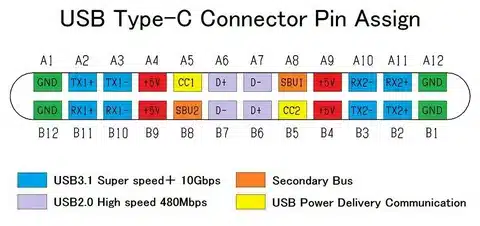
USB Type-C connector pin assignment chart with functions
Uncategorized

Usb Type-C Pin layout: Complete Guide to Power, Data & Connectivity

The USB Type-C pin layout is designed for versatility, packing 24 pins into a compact, reversible connector that supports power delivery, high-speed data transfer, and multiple connectivity standards. Its symmetrical design allows the same orientation on both ends, while dedicated pins handle functions such as USB 2.0 and USB 3.x data lanes, power delivery up to 100W (and beyond with USB PD 3.1), video output through DisplayPort or HDMI Alt Mode, and configuration channel (CC) pins for orientation and role detection. By integrating power, data, and video into one universal port, Type-C simplifies connections across laptops, smartphones, and peripherals, but actual performance still depends on the supported protocols of the device and cable.

detailed close-up of USB-C charging cable head
Uncategorized

Does Android Use USB-C? The Complete 2025 Android Charging Guide

The article “Does Android Use USB-C? The Complete 2025 Android Charging Guide” explains that nearly all modern Android smartphones and tablets now rely on USB-C as the standard charging and data transfer port, replacing the older micro-USB. USB-C offers faster charging speeds, higher power delivery, quicker data transfers, and universal compatibility with a wide range of devices. The guide highlights differences between standard USB-C cables and USB-C with Power Delivery (PD) for fast charging, and it also addresses common issues like cable quality, charger wattage, and device compatibility. By 2025, USB-C has become the unified standard across Android brands—streamlining accessories and making charging more efficient and reliable.

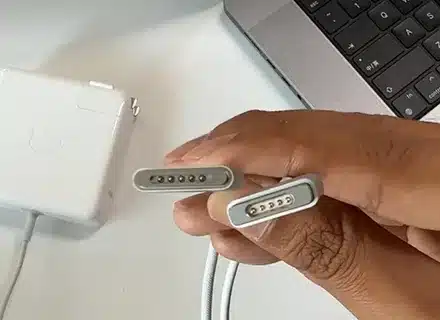
Hand holding MagSafe 2 and MagSafe 3 connectors for comparison
Uncategorized

USB-C vs MagSafe: Are Cheap Magnetic Adapters Worth It in 2025?

In 2025, the debate between USB-C and MagSafe-style charging centers on convenience versus reliability. Cheap magnetic USB-C adapters mimic Apple’s MagSafe snap-on ease and can protect ports from accidental tugs, but they often come with trade-offs. Many low-cost versions struggle with high-wattage charging, limit data transfer speeds, and pose safety risks like arcing or overheating due to poor build quality and lack of official USB-IF certification. While newer MagSafe and Qi2 chargers have improved wireless power delivery and safety standards, most inexpensive magnetic adapters remain best suited for light use rather than heavy, daily fast-charging. In short, they can be handy accessories for convenience, but investing in reputable, certified products is essential if you value long-term device safety and performance.

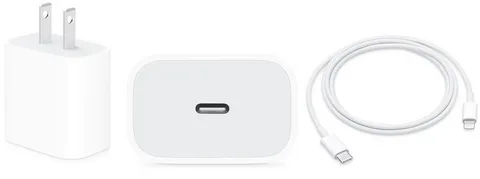
Apple USB-C power adapter shown with charging cable and block
Uncategorized

Can You Use Any USB-C Charger for Iphone 15? Complete Charging Guide

The article “Can You Use Any USB-C Charger for iPhone 15? Complete Charging Guide” explains whether all USB-C chargers are safe and effective for the iPhone 15. It highlights that while the iPhone 15 now supports USB-C, not every charger delivers the same speed or performance. Apple recommends using certified USB-C chargers with Power Delivery (PD) to ensure fast charging and device safety. Cheaper or uncertified chargers may still work but could result in slower charging, overheating, or long-term battery damage. The guide also covers wattage requirements, cable quality, and compatibility with third-party accessories, helping users choose the best charger for reliable and efficient charging.

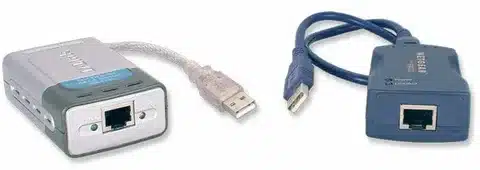
Two types of USB to LAN converters with Ethernet ports for connecting devices to wired networks
Uncategorized

How To Use USB To Ethernet Adapter: Ultimate Setup Guide for Faster & More Stable Internet

A USB to Ethernet adapter is a simple tool that lets you connect devices without built-in Ethernet ports—like many modern laptops and tablets—to a wired internet connection for faster, more stable network performance. Setup is straightforward: plug the adapter into a USB or USB-C port, connect it to your router or modem with an Ethernet cable, and most operating systems will automatically recognize it without extra drivers. This solution is especially useful for online gaming, video streaming, or large file transfers where Wi-Fi may be inconsistent. In short, a USB to Ethernet adapter offers a quick, reliable way to boost connectivity and minimize lag or dropouts.

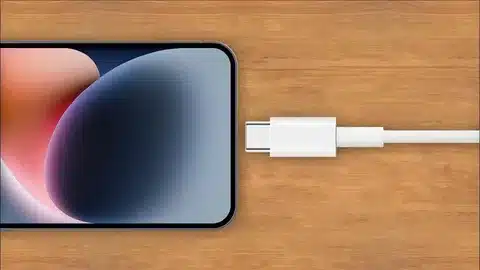
iPhone 15 connected to USB-C cable while charging on desk
Uncategorized

Does iPhone 15 Have USB-C? Complete Guide to Apple’s New Connector

The article “Does iPhone 15 Have USB-C? Complete Guide to Apple’s New Connector” explains Apple’s transition from the Lightning port to USB-C on the iPhone 15 lineup. It confirms that all iPhone 15 models now feature a USB-C connector, making charging and data transfer more universal and compatible with a wide range of devices. The guide details the benefits of this change, such as faster data transfer speeds on the Pro models, improved charging convenience, and reduced need for multiple cables. It also discusses differences between standard USB-C and higher-speed Thunderbolt support, along with what users should know about cables, chargers, and accessories for the new connector.

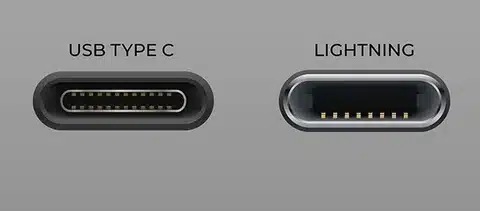
USB Type-C port compared with Apple Lightning port
Uncategorized

What Is a Lightning Port Cable? Your Complete Guide to Apple’s Essential Connector

A Lightning port cable is Apple’s proprietary connector introduced in 2012 to replace the older 30-pin dock system, designed to provide a compact, reversible, and multifunctional interface for iPhones, iPads, and some accessories. It supports charging, data transfer, and audio output through a single cable, with Apple’s authentication chip ensuring compatibility and safety. Unlike USB-C, which is an industry standard, Lightning remains exclusive to Apple devices, giving the company control over accessory quality through its MFi (Made for iPhone) program. While it offers ease of use and durability, its slower data transfer speeds and limited universality compared to USB-C have sparked debate, especially as Apple gradually transitions newer products toward the USB-C standard.

Scroll to Top

GET A QUOTE