
Custom Cable Design Services for High-Speed and Industrial Applications
From concept review and prototype development to testing and scalable production, Kingda helps customers build custom cable assemblies designed for performance, fit, and long-term reliability.
Built for server, storage, industrial equipment, and data transmission applications.
Why Custom Cable Design Matters
A custom cable assembly is built around the needs of the equipment, not the limitations of a standard part. This approach helps improve fit, reduce installation issues, support signal performance goals, and create a more reliable interconnect solution for the final product.
With the right design input early in the project, customers can avoid unnecessary complexity, reduce rework during integration, and align cable construction with operating environment, routing space, and connector requirements.
Benefits of custom cable design
- Optimized cable length for cleaner routing and easier installation.
- Connector selection based on interface, orientation, and equipment layout.
- Better support for shielding, signal integrity, and durability requirements.
- Material choices matched to temperature, movement, and environmental conditions.
- A smoother path from prototype approval to volume production.
What We Can Customize
Every project has different electrical and mechanical constraints, which is why custom cable development usually starts with a detailed review of structure, materials, interfaces, and application conditions. Our team works with customers to define the cable assembly around the actual use case rather than forcing the use case to fit a stock design.
We can customize
- Cable type and transmission standard
- Connector type, mating interface, and orientation
- Cable length and breakout configuration
- Wire gauge, conductor structure, and shielding
- Jacket and insulation materials
- Labeling, marking, and identification options
- Overmolding and assembly protection
- Flexibility, bend radius, and installation constraints
- Prototype quantity and production volume planning
Supported product directions include
- MCIO cables
- PCIe Gen5 cable assemblies
- Mini SAS HD cables
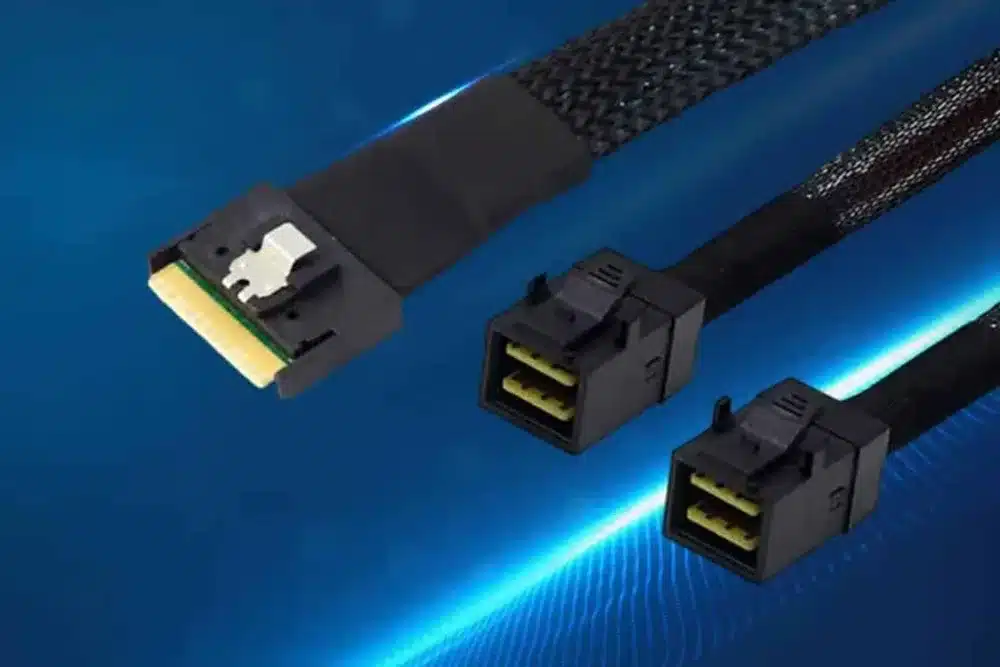
- SlimSAS cable assemblies
- OCuLink cables
- U.2 8639 cables
- SFP and QSFP cable assemblies
- USB 3.1 and USB4 cable solutions
Our Custom Cable Design Process
A strong custom cable project follows a structured path that usually includes requirement review, design definition, prototype build, testing, and production release. This process is widely recognized across the industry because it helps confirm that the final assembly matches both performance targets and manufacturing realities.
Requirement Review
We begin by understanding your application, interface, signal requirements, space limitations, cable routing conditions, and expected operating environment. This step helps define the practical and technical boundaries of the project before design decisions are made.
Engineering Evaluation
Based on your requirements, we evaluate suitable cable structures, connector options, shielding methods, materials, and manufacturable assembly details. The goal is to develop a cable design that supports both performance and production feasibility.
Prototype Development
Once the design direction is confirmed, we support prototype builds for fit check, function review, and early-stage validation. Prototyping plays an important role in identifying issues before a project moves into production.
Testing and Refinement
Prototype assemblies can then be reviewed for application fit, consistency, and performance. Refinement at this stage helps improve reliability, manufacturability, and deployment confidence before release.
Production Support
After approval, the project moves into controlled production with quality inspection and delivery planning. Keeping design, prototyping, and production aligned under one supplier can reduce communication gaps and improve execution efficiency.
Custom Cable Design for High-Speed Transmission
High-speed cable assemblies require more than basic connectivity. They need careful attention to interface compatibility, cable structure, shielding, routing limits, and consistency across production so the final assembly can support signal transmission requirements in real equipment environments.
Kingda focuses on high-speed transmission cables used around servers, storage systems, and industrial equipment. For customers developing new systems or optimizing existing hardware, custom cable design can help align the interconnect solution with space constraints, connector selection, and performance expectations from the beginning of the project.
From Prototype to Production
A custom cable design is only useful if it can be manufactured consistently. Industry best practice emphasizes not just the initial design, but also material selection, prototype validation, manufacturability review, and production control before shipment.
At Kingda, we approach custom cable projects with that full lifecycle in mind. Our goal is to help customers move from concept to stable supply with cable assemblies that are designed around actual application needs, verified through prototype review, and prepared for repeatable production.